Popular Science Disproves Virgin Birth with SCIENCE!!! (CaPC)

virgin and ChildPopular Science wants you to know that a human virgin birth (or, more properly ‘virginal conception’, not ‘immaculate conception’, which is something entirely different) is pretty impossible. While “parthenogenesis” has been known to happen in non-mammalian species, there are a couple of obstacles to that happening for us:

So what stands in the way? First, a mammal’s egg cell usually won’t divide until it receives a signal from the sperm. Second, most mammalian eggs have only half the number of chromosomes necessary for development. If there isn’t any sperm, the embryo will end up with only half the DNA it needs to survive.

Both of those barriers could potentially be overcome in the lab or through random mutation, but there is a third obstacle that probably can’t be. Under normal conditions, the DNA in both egg and sperm cells is altered such that some genes will be more active while others are suppressed. When the egg and sperm join to form an embryo, these imprints work in tandem, ensuring that all the necessary proteins are produced in the right amounts. If an egg cell starts reproducing on its own, without the sperm-cell imprint, the offspring won’t survive for very long.

Scientists estimate that imprinting affects about 200 different genes. For parthenogenesis to occur, many of these changes would have to occur through random mutation. “I just think it’s too complex and you’d need too many things to happen accidentally,” says Marisa Bartolomei, a molecular geneticist at the University of Pennsylvania. While highly unlikely, it’s still theoretically possible that scientists could one day induce the necessary changes in the lab. “Is there a mutation that could eliminate all imprinting, so we would see that we didn’t need Dad or Mom in order to have normal development?” Bartolomei asks. “This is a question that people have asked a lot, and we don’t know the answer.”

So there you have it. Guys, we might have been excited about Christmas coming, but SCIENCE has shown us that virgin births can’t happen, so if you want to celebrate, fine. Just trade in your nativity scenes for Santa and his flying reindeer, or realize they’re both just pleasant but impossible holiday myths. Right.

Now, to be fair, the guy didn’t strictly say this is about Christmas. Nor did he single out Jesus’ birth as impossible, or actually draw the explicit conclusion that it’s all a myth that pre-scientific believers swallowed whole because they didn’t know any better. Sure, it was titled “Could a Virgin Birth Ever Happen?” and had a painting of the Mary with the baby Jesus in her hands, but, you know, that could mean anything.

Still, were it the case that this little article was intended to imply something of the sort, in the way that popular Dawkins-style unbelievers, or old-school liberals like John Shelby Spong typically tend to, I’d like to point out a few key lines of Christian thought to quickly cut that off.

You can read the rest of my response over at Christ and Pop Culture.

Tim Keller: 4 Doctrines You Need To Know When You’re Suffering

walking with GodI just began Tim Keller’s monumental new book on the problem of evil Walking with God through Pain and Suffering and it’s, well, it’s monumental. I’ve read a number of books on the subject, especially in my undergrad in philosophy, and I have to say, though I’m only a couple of chapters in, it’s going to be the new classic on the subject. Unlike other works on the subject, he’s not only pastoral, or only philosophical, or only theological, but he approaches the issue of suffering from all of these angles and more. Sociology, literature, theology, philosophy, and, of course, the Scriptures, are brought to bear on the seemingly intractable burden of suffering and evil.

While we can’t logic ourselves out of pain, making meaning of our suffering is inevitable, and the framework through which you view life reveals itself most clearly in our approach to pain. Without doing a full review, I wanted to simply highlight a key little section towards the beginning where he, in short order, lists four key doctrines of the Christian faith that give deep resources for dealing with pain, suffering and evil over and against the secular or deistic view (numbers are mine):

  1. “The first relevant Christian belief is in a personal, wise, infinite, and therefore inscrutable God who controls the affairs of the world–and that is far more comforting than the belief that our lives are in the hands of fickle fate or random chance.
  2. The second crucial tenet is that, in Jesus Christ, God came to earth and suffered with and for us sacrificially–and that is far more comforting than the idea that god is remote and uninvolved. The cross also proves that, despite all the inscrutability, God is for us.
  3. The third doctrine is that through faith in Christ’s work on the cross, we can have assurance of our salvation–that is far more comforting than karmic systems of thought. We are assured that the difficulties of lie are not payment for our past sins, since Jesus has paid them. As Luther taught, suffering is unbearable if you aren’t certain that God is for you and with you. Secularity cannot give you that, and religions that provide salvation through virtue and good works cannot give it, either.
  4. The fourth great doctrine is that of the bodily resurrection from the dead for all who believe. This completes the spectrum of our joys an consolations. One of the deepest desires of the human heart is for love without parting. Needless to say, the prospect of resurrection is far more comforting than the beliefs that death just takes into nothingness or into an impersonal spiritual substance. The resurrection goes beyond the promise of an ethereal, disembodied afterlife. We get our bodies back, in a state of beauty and power that we cannot today imagine. Jesus’ resurrection was corporeal–it could be touched and embraced, and he ate food. And yet he passed through closed doors and could disappear. This is a material existence, but one beyond the bounds of our imagination. The idea of heaven can be a consolation for suffering, a compensation for the life we have lost. But resurrection is not just consolation–it is restoration. We get it all back–the love, the loved ones, the goods, the beauties of this life–but to knew, unimaginable degrees of glory and joy and strength. It is a reversal of the seeming irreversibility of loss…”

Walking with God through Pain and Suffering, pp. 58-59

Note clearly: this is no mere theism with general platitudes about everything working itself out, or karma, or what-have-you, but concrete consolation grounded in deep Gospel truth revealed in the cross and resurrection of Jesus Christ. Even the first doctrine of God’s inscrutable wisdom is one grounded in fact that Jesus was “delivered up according to the definite plan and foreknowledge of God” (Acts 2:23), for our salvation.

Clearly we could expand on all of these (and Keller will), but these four thick truths of the Christian faith are the key doctrinal pillars upon which any properly Christian response to suffering will rest. This is how the Christian begins to deal with the problem of pain and suffering. Once more, this is why doctrine matters for real life.

Soli Deo Gloria

The Importance of Context in the Conquest of Canaan (The Story Notes #7)

jerichoMy church is, across all departments, going through The Story, a chronological, abridged edition of the Bible that takes you through the story of Scripture from Genesis to the end of Acts in 31, novel-like chapters. It’s a fun project that’s challenging me to deal with narrative sections, teach large chunks at a clip, and point my kids to Christ throughout the whole redemptive-historical story-line of the text.

That said, it seemed worth it to start posting my notes for these talks on a regular basis. It might happen every week, or not, depending on how helpful I think it is, or time constraints. My one request is that you remember these are pretty rough notes and I’m teaching my students, not a broader audience.

Text – Joshua 6 and the Invasion of Jericho

While a lot of us have trouble with most of what they read in the Old Testament, up until now a lot of us could get by okay. Let’s not play around here, though–there is a serious difficulty for many of us reading and understanding texts like this. The invasion and conquest of Canaan presents an assault on the modern mind, with modern sensitivities, horrified at what strikes us as a simple war of conquest in the name of God. We live in a post-9/11 world and the specter of religious terrorism, and not to mention modern ethnic cleansing, so this stuff understandably terrifies us.

Problem is, it seems like the Bible is full of awkward sections like this. What do we do with these pictures of violence? Or all the weird laws that we find in the Torah? How do we accept them as the word of God and possibly relate them to our own lives when they seem so terrible? We have to do something with them don’t we? This isn’t just an academic question for a lot of us. These are the texts that get thrown in our faces by our atheist and agnostic classmates when the Bible comes up. And, if we’re honest, they’re the ones that keep some of us up at night, doubting if what we’ve been taught in Sunday School is really all just a made-up, human construction.

What I want to do tonight is try to deal with this text, yes, but also the importance of reading the troubling texts of Scripture in context. In this case there are three contexts that I would tell you that you have to consider: historical, redemptive-historical, and the Gospel. But to set that up, let’s recap the story.

The Story Recap– At this point, the 40 years are up, and the Israelites are beginning to enter and take the promised Land. Joshua, Moses’ Second in Command, is now leading Israel’s armies and beginning to fight the Amalekites, and the rest of the Canaanite peoples, in order to take possession of it. That’s pretty much the story so far from last week.

1. Historical Context – So, here they are, about to take the ‘city’ of Jericho, and here’s where it becomes important to start examining the first context, the historical one, in order to understand what we’re reading.

a. Geopolitical-Theological Power Centers – Most of us, when we hear about a city like Jericho, make the mistake of thinking of a modern city, or maybe an old town, filled with normal life, families, etc. with Israel camping around, ready to invade. Here’s where modern archeology and biblical scholarship begins to shed some light. See, the reality is, most of the “cities” we see listed as being taken are really concentrated military/political/theological centers that controlled the regions.

They were small, maybe about the size of Trinity (our church campus). Realize, this is not LA or even Tustin we’re talking about. These were small, composed of maybe a couple hundred people which is why Israel can march around seven times in one day, and then still have the energy to conquer it. Beyond that, they consisted of military personnel, local royalty, slaves and prostitutes, with the civilian populations (if significant) living outside the walls. This was an attack on the equivalent of a key military base.

And here we come to something important: there is every reason to think that these civilian populations cleared out as the armies approached. There are a number of texts in the Law and in Exodus where God promises to “drive them out” before the Israelites:

I will send my terror in front of you, and will throw into confusion all the people against whom you shall come, and I will make all your enemies turn their backs to you. And I will send the pestilence in front of you, which shall drive out the Hivites, the Canaanites, and the Hittites from before you. I will not drive them out from before you in one year, or the land would become desolate and the wild animals would multiply against you. Little by little I will drive them out from before you, until you have increased and possess the land. –Exod 23:27-31

So, when Rahab talks about the “Fear” that had fallen on the land, there is the strong implication that most of any civilian population had cleared out before the Israelites ever got there. If they didn’t, before, then after 7 days of watching Israel marching around the gates, they did. These were not large massacres, but strategic strikes on key religious and political centers.

b. War Hyperbole and Rhetoric-– Beyond that, we need to address the language about total destruction in these texts right? Because we read these awkward phrases about “men and women and children”, “left no one breathing”, “left no survivors”, etc. According to Scholar Paul Copan we need to know that this is typical Ancient Near Eastern War Rhetoric:

This stereotypical ancient Near East language of “all” people describes attacks on what turn out to be military forts or garrisons containing combatants — not a general population that includes women and children. We have no archaeological evidence of civilian populations at Jericho or Ai (6:21; 8:25).8 The word “city [‘ir]” during this time in Canaan was where the (military) king, the army, and the priesthood resided. So for Joshua, mentioning “women” and “young and old” turns out to be stock ancient Near East language that he could have used even if “women” and “young and old” were not living there. The language of “all” (“men and women”) at Jericho and Ai is a “stereotypical expression for the destruction of all human life in the fort, presumably composed entirely of combatants.”9 The text does not require that “women” and “young and old” must have been in these cities — and this same situation could apply to Saul’s battling against the Amalekites.

So we have good reason to doubt that there was even close to the picture of  families and dense, civilian populations here. And this is not an issue of the text lying either. This is typical ANE war rhetoric and most people would have heard and read it that way.

c. Infiltration as Well — This is backed up by the fact that If you look at the earlier sections of the Law, there are dozens of laws talking about not inter-marrying with people of the land, or later on in Judges, the Bible talks about fights with the Canaanites, that assume they weren’t all wiped out, but continued to be a significant presence in the land. Again, as we saw in this Exodus text, the strategy wasn’t coming in and actually totally wiping people out, but slowly infiltrating key power centers and moving into the land that way. This is not the indiscriminate wholesale slaughter that we might be tempted to picture.

These and a number of other historical factors need to be considered when reading these texts. We live at a distance of thousands of years from these text and bring assumptions to it that the original readers wouldn’t have shared, and don’t assume things that they would have. So whenever you run across a difficult text in the OT, realize that there are a times when a lot of confusion and heart-ache can be avoided with a good commentary and some historical scholarship. Not entirely, of course, but still significant.

2. Redemptive-Historical Context – That said, the historical context isn’t the only one to consider. Another level that we have to consider is the “Redemptive-historical” context–or the whole story of the Bible. These events take their place in a longer story and must be understood within that context or they don’t make sense.

a. God’s patient judgment – One angle on this is to consider why God says he is driving out the Canaanites. Back in Genesis 15:13-16 God says:

Then the Lord said to Abram, “Know for certain that your offspring will be sojourners in a land that is not theirs and will be servants there, and they will be afflicted for four hundred years. But I will bring judgment on the nation that they serve, and afterward they shall come out with great possessions. As for you, you shall go to your fathers in peace; you shall be buried in a good old age. And they shall come back here in the fourth generation, for the iniquity of the Amorites is not yet complete.”

Then again, we read in Deuteronomy 9:4-5:

“Do not say in your heart, after the Lord your God has thrust them out before you, ‘It is because of my righteousness that the Lord has brought me in to possess this land,’ whereas it is because of the wickedness of these nations that the Lord is driving them out before you.  Not because of your righteousness or the uprightness of your heart are you going in to possess their land, but because of the wickedness of these nations the Lord your God is driving them out from before you, and that he may confirm the word that the Lord swore to your fathers, to Abraham, to Isaac, and to Jacob.”

In these texts we see that God was using the Israelites as his sword of judgment. This is not God just looking around at random and destroying a people. The cultures that were invaded were abysmally dark, notorious for their rampant injustices towards the weak and the poor. They were conquerors and bloody bullies who soaked the land in blood and death. These are not peaceful monasteries in Tibet we’re talking about here. Their worship was corrupted to the point that it involved bestiality, temple prostitution (which like involved sex-slavery), and, most horrifying of all, child sacrifice. We have archeological digs with pits, full of the skulls of children these cultures offered up to the flame. As an associate of mine pointed out, just consider Rahab the prostitute–how weird is it that she was willing for invaders to come? No, for her, and those like her, this was not just invasion, but in many ways, liberation.

See, God tells us that he is the God who care about poor, powerless, etc. He cannot and will not let injustice go on forever and so, at times, his final judgment breaks out in the present in order to stop gross injustice. Beyond that, in the first text we see that God waited 400+ years for the people to become corrupt enough to justify thing. He didn’t just pick a land and take it, he waited until the culture became so corrupt and wicked that their judgment was merited and necessary. This was God’s extreme patience towards the Canaanites–he waits hundreds of years for their sin to ripen and mature (far longer than we probably would have), until even God’s patient mercy must give way to judgment.

b. God will give them no taste for conquest — The other thing we need to note is that this is not a set-up for empire-building. In Deuteronomy he commands them not to have standing armies, chariots, or any of the other paraphernalia of empires. This a limited project, undertaken at one time, for a specific purpose. This is not a program of Empire to be appropriated later, or used to justify other violence. “You get this land, about half the size of California and no more.” This is part of the logic of the total destruction of these key sites. Israel is not to get a taste for war. And you see in the rest of the OT, the rest of the Yahweh-approved wars are fought defensively.

c. God’s other purpose is to create a Redemptive Space — The second reason that needs to be considered is what were God’s purposes with Israel. God had project: he wanted to create a people through whom the world would see what God was like. What’s more, the ultimate goal is not for Israel alone, but that all the nations of the world may be saved and blessed by God through Israel in the coming of her Messiah. For this to happen, Israel needed a land, a space to develop a culture as a people, set apart from other peoples, for the redemption of all peoples. They needed space to practice the 10 commandments. A set-apart, holy land devoted to justice, peace, and the true worship of God, in a way that would be un-corrupted by the local Canaanites and their distorted practices.

This is another, if not the key reason to understand that this was not a whole-sale killing, genocide or ethnic-cleansing. Israel took Rahab and her family in as they acknowledged the true God, and as a friend pointed out, this is likely just a shadow of Israel’s mercy to other people–the accounts don’t cover everything. Just as they included repentant Egyptians in the crowd as they left Egypt, it is not unlikely that repentant Canaanites could join the people. Of course, this points ahead to the Gospel of Jesus and the inclusion of the Gentiles. Clearing out the nations serves the purpose of one day bringing in the nations.

So what we’re seeing then, is a tactical, limited invasion, whose goal was to establish beach-heads, driving out the surrounding peoples and their corrupt cultures slowly. Why? For God’s specific, purposes of judgment on a wicked people, and the grand redemptive purpose of saving all peoples. (Incidentally, this is why this can’t be used as a warrant for modern violence–different covenant, no divine command, etc.)

This is where I make an analogy that might not work. Most of us look back at WW2 and think there was a lot of horrible stuff that happened on both sides. I mean, I think I’m only now reconciling myself to the horror of the firebombing of Dresden and the terror of Hiroshima. These were…damnable. Thing is, with all of Europe in the choke-hold of a monster, and the gaping jaws of Auschwitz and the camps devouring millions of Jews, I don’t think any of us would say that no bullets should have been fired or that no bombs ought to have been dropped.

If that holds true for the temporal salvation of some people and one point in history, how much more then for the salvation of the whole world? Again, this may not work for you. I get that. I’m not sure it does entirely for me either. Still, it might put the breaks on our rush to rule this out as something God “couldn’t” do. We have a God who has committed to saving historical beings, precisely in history. We shouldn’t be surprised if that involves some messy moments.

3. Theological Context of Christ – Of course, the final context I would say we need to look at this in, is the Gospel of Jesus Christ. On the one hand, you can’t understand Jesus without the rest of the story of the Bible. On the other, you can’t understand the story of the Bible without look at the Gospel of Jesus. The life, death, and resurrection of Jesus are like a light at the center of the Story-line that allows us to see all things properly in its light.

In this case, I think the Gospel reminds us of a couple of big-picture theological truths that we need to keep in mind when we look at these stories.

God Hates Sin – One thing these texts remind us of is the radical seriousness with which God takes sin. I was talking to a buddy the other day and he was telling me how it just really occurred to him that God hates sin–like, he really can’t stand it to the core of his being. But honestly, that’s a good thing, right? If God is good, loving, just, great, righteous, and holy, he really can’t love sin. He can’t and shouldn’t put up with it forever, right? I mean oppressing the poor has to end sometime right? Violence, arrogance, racism, rape, child-sacrifice, sex-slave trade, and idolatry can’t go on forever. And we don’t want it to.

This is what we see in the Cross of Jesus. The cross of Jesus is God judging sin for what it is–something damnable and horrifying–something that has not place in God’s world and will ultimately be done away with. What happened to Jesus is what ought to happen to us, and will, if we don’t allow him to be judged in our place.

God Loves Sinners – Now, while that’s one truth we need to see, there’s a far deeper one beneath it that is essential for us to consider–God loves sinners:

For while we were still weak, at the right time Christ died for the ungodly. For one will scarcely die for a righteous person—though perhaps for a good person one would dare even to die—but God shows his love for us in that while we were still sinners, Christ died for us. Since, therefore, we have now been justified by his blood, much more shall we be saved by him from the wrath of God. For if while we were enemies we were reconciled to God by the death of his Son, much more, now that we are reconciled, shall we be saved by his life. (Romans 5:6-10, ESV)

The fundamental truth about God that we see in the Cross and resurrection of Jesus Christ is that his will is to save them. He loves them. He doesn’t want to judge us. He doesn’t want to ultimately condemn us. He is just, so if we refuse to turn, if we continue to hate good and choose evil, well, he’ll let us do that and suffer the consequence. But his deep desire is to draw us to himself. He looks at us and says, “Though I can’t stand what you’ve done, both to me, your neighbor, and yourself, yet I love you. I would separate you from your guilt. I would remove from you your sin, that I might hold you to my own heart that loves you still.”

So in order to do that, he suffers judgment himself. Realize, the God we see in the OT, is the same God who was willing  to become a man and suffer the worst pain that anyone in human history has ever faced. This is the God who suffers the rejection of Hell for us, so that we might not face it. In the end, God conquers sinners through judgment–His own, on the Cross. This is ultimately what I have to look to.

We’ve gone through a lot of these different contextual issues and historical considerations that change the shape of how we think about these text. They’re important to consider and helpful as we wrestle with the awkwardness of the story of scripture. At the end of the day, though, I have to put my trust in that God is who I see in Jesus Christ and him crucified–the God who proved himself perfectly just and perfectly loving in a way I could have never imagined. I never could have fathomed a God so good he was willing to die for those who wanted to put him to death in order to save them from death.

So when I come to these troubling texts, no, I don’t just read them and say, “Welp, it’s the Bible, so, no problem here.” I have doubts and struggles. What I do say is, “God, you’ve already proven yourself to be unfathomably just and unfathomably loving beyond my finite and fallen comprehension. I still don’t have a grid for the Gospel. I’m having trouble accepting this, but I trust you, so shine a light on this.” Then I wait. I study, pray, and wait. And you know what? I think God’s okay with that.

If you’re struggling tonight, that’s okay. Church is meant to be a place where, yes, we confess, praise, trust, and grow. It also should be a place where you can safely struggle. What I do hope you’ve seen is that when it comes to difficult texts, context matters–a lot. And can make a big difference. So before you chuck your Bible across the room, slow down, ask questions, do a little digging and prayer and trust God to show up.

Soli Deo Gloria

Okay, so, I know this is an incomplete treatment of the text, or even the whole conquest. I didn’t address God’s rights as creator, scratch the surface of the epistemological issues, moral grounding, and the authority of scripture over culture. Honestly, I had a half hour, and I try not to push my students beyond that. For those who are interested in exploring the question in greater depth, I would commend these resources to you:

1. Is God a Moral Monster? by Paul Copan – This has three chapters devoted to the question of the context that are extremely helpful on this question.
2. How Could God Order the Killing of the Canaanites? by Paul Copan – Short article summarizing much of the book.
3. Is YHWH a War Criminal? by Alastair Roberts — Another thoughtful, article-length treatment of the subject.

Why You Can’t Pit Jesus Against His Bible (@TGC)

Every so often, the champions and foes of “Red Letter” Christianity break out their arguments, sharpen them up, and take to the internet. Champions say we’ve ignored the words of Jesus—highlighted in some modern Bibles with red lettering—for far too long. They want us to take up the radical call to discipleship Jesus issued in the Sermon on the Mount. The foes say that even printing these words in red creates a false, canon-within-a-canon that distorts the Scriptures.

it_is_finishedOf course, there is a good sense in which we ought to give heightened priority to the words and deeds of Jesus. Unfortunately, some other self-described, “Red Letter” Christians do more than them priority. Instead, they contrast and even set in opposition the words of Jesus from the writings of Paul, or some other similarly ill-tempered and unprogressive disciple. While problematic, that approach is even less concerning than the tendency to pit Jesus against the Bible he grew up with: the Old Testament. Jesus’ words and character are contrasted with the Old Testament law, or the various commands of God scattered throughout the narrative sections of the Torah. So where Jesus and the Old Testament seem to conflict on violence, neighbor-love, sexuality, or some other hot topic, go with Jesus, they say. If you have to pick between red or black letters, go with red.

At the risk of kicking off another round of ‘robust dialogue’, here are three reasons why that approach doesn’t really work.

You can read the reasons over at The Gospel Coalition.

Tim Keller on Judges and OT Violence

KellerLast week I wrote a post engaging with Brian Zahnd on the issue of the authority and inspiration of the Old Testament. In dealing with the issue of the conquest narratives in Joshua and other places, a lot of people have trouble dealing with the apparent tension of the grace, love, peacableness, and forgiveness found in the New Testament with God’s commands to judge and destroy the Canaanites in the Old. Some will quickly move to justify the texts, not dealing with the understandably troubling nature of the narratives, while others will simply write them off as remnants of a more savage time to be left behind now that we have Jesus.

Well, the question came up again this week in Matt Smethurst’s interview article (and by the way, he does great interviews) over at the Gospel Coalition with Tim Keller on why Keller had written a study guide to the book of Judges:

Smethurst: The Israelite conquest of Canaan appears to give warrant for imperialism, holy war, and genocide. How can enlightened modern people take a book like Judges seriously?

Keller: Yes, in teaching the book of Judges you simply have to deal with this issue—you can’t ignore it. And in this brief space I can’t even list the issues and the various objections and answers. Maybe the most fundamental thing to say is that if you believe the rest of what the whole Bible teaches—that there’s only one true God, that for a period of time he spoke directly to Israel through prophets and through the Urim and Thummim in the priest’s breastplate, but that now, since Christ, he speaks to us through his inscripturated Word—then the conquest of Canaan makes sense.

Why? First, God alone has the right to judge people—only he knows what they deserve and what they will do if not stopped. He alone has the right to take a life. Second, in “holy war” Israel did not seek to imperialistically expand its wealth and power but acted as an instrument of God’s judgment on a particular set of people. Third, if you believe in the authority of the Bible as the only infallible way to know God’s will for us—then holy war today is impossible. God gives no warrant for it. That’s what we see when reading the Bible is read as a whole, with the New Testament completing and fulfilling the Old. Jesus specifically forbids Christians to take up the sword in his name, to spread the Christian faith by force. In short, if you believe the rest of the things the Bible teaches, the period of holy war makes sense. Holy war is not, therefore, a reason to reject what the rest of the Bible says about God.

Note very clearly, Keller says that there are more concerns and more objections to be dealt with. Away with any suggestion that Keller deliberately ignored a host of problems. What he does do is raise three that help to address the charge that the OT narratives are indefensible and encourage violence.

  • God is the final, trustworthy judge.
  • Holy war served a limited, focused purpose in God’s economy: the judgment of people with whom he had been patient for hundreds of years.
  • The narrative logic of the whole of Scripture forbids violence to Christians for spreading the faith.

That last one deserves a bit more comment. Often-times you’ll see a biblical critic point to a particular text and say, “See, there, that story encourage X behavior (misogyny, violence, ecological carelessness, etc.). We can’t trust it and must move past it.” Or, they’ll simply use it as evidence that the Bible as a whole is flawed. The problem here is, yes, a problematic text, but even more, the fact that atomistic readings can distort the shape of any kind of text. This is one more example of why historical, narrative, and canonical context matters. You don’t know the meaning of any story, or really, any scene in a story, until you’ve reached the end.

And what do we see in the book of Judges when we reach the end of story, the full story that finds its climax in Jesus Christ? Keller says we can’t help but see Jesus:

He’s the ultimate judge—the perfect and unflawed Gideon and Samson. He is the ultimate king we don’t yet have but whom we need. Even at the terrible end of Judges, where a man gives up his spouse to death to save his own skin, we can’t help but think of Jesus our true husband who gives himself up to death in order to save us. Jesus in Judges, as usual, is everywhere.

This is why we need to be careful when dealing with the OT. If you simply rush to judgment, writing things off quickly because of a contextless, atomistic, moralistic reading, you might miss Jesus in the middle of it.

Soli Deo Gloria

P.S. I’d commend the whole interview to you here. Also, again, I’d commend this article by Paul Copan dealing with historical issue with the Canaanite conquest and OT violence.

Comfort for Slaves in the NT

Bondservants, obey in everything those who are your earthly masters, not by way of eye-service, as people-pleasers, but with sincerity of heart, fearing the Lord. Whatever you do, work heartily, as for the Lord and not for men, knowing that from the Lord you will receive the inheritance as your reward. You are serving the Lord Christ. For the wrongdoer will be paid back for the wrong he has done, and there is no partiality. Masters, treat your bondservants justly and fairly, knowing that you also have a Master in heaven. –Colossians 3:22-4:1

servantOur experiences with the Civil War, the slave trade, and the Civil Rights movement made us particularly sensitive to the way certain texts have been used by those in power to oppress others. Certain verses in the NT in especially, like Paul’s household codes have been pointed to as encouraging slavery and subjugation. In some cases, they have been seen as evidence of the diversity of theologies in the NT on this issue. J.D. Crossan, for instance, sees them as evidence of a drift in the early church from a more liberated Paul (the undisputed letters), to a conservatising Pauline theologian (Ephesians, Colossians), and finally to a traditionalist disciple (the pastorals.)

Now, while I think these issues have been dealt with and adequately explained by modern NT scholars, it’s encouraging to note that long before the disturbing history of the colonial slave trade, Christians had been wrestling with what to do with these texts. For instance, commenting on this text in Colossians, Calvin doesn’t find a program for oppression, but rather a deep comfort for those who find themselves ‘under subjection’:

By the former statement he means, that service is done to men in such a way that Christ at the same time holds supremacy of dominion, and is the supreme master. Here, truly, is choice consolation for all that are under subjection, inasmuch as they are informed that, while they willingly serve their masters, their services are acceptable to Christ, as though they had been rendered to him. From this, also, Paul gathers, that they will receive from him a reward, but it is the reward of inheritance, by which he means that the very thing that is bestowed in reward of works is freely given to us by God, for inheritance comes from adoption.

-Comment on Colossians 3:22-25

Calvin sees at least three sources of comfort here: First, when the slave/bondservant renders his service willingly, he transform it from an instance of subjugation, to another opportunity to freely do honor to his Lord. Instead of work stolen from him by a powerful master, the servant of Christ transvalues it in faith and renders the work an act of spiritual freedom despite whatever political situation of oppression he finds himself in. This is a spiritually subversive counsel.

Second, this is a real source of blessing because the God who has adopted us, sees our faithfulness in this difficult situation and will surely reward us for it. Trial though it may be, God the Father of our Lord Jesus Christ, who made himself a slave for us, will see that the good works of his oppressed are crowned with glory.

Third, the justice of God is testified to here. In the world there may be no justice, but God does not judge things by outward appearance, but rather will repay masters according to the way they treat their workers. No, God has not forgotten his children in trying situations, but jealously will act in justice on their behalf. All wrongs will be righted and so the Christian can wait on the Lord, trusting him to take care of those situations which are beyond our control.

No, far from being a mere conservatising reinforcement of the status quo, we have here a pastorally appropriate word of comfort to real people dealing with a situation they likely had little control over. There is deep assurance here that the God they have found in Jesus Christ cares for the lowliest slave and that his work of judgment and salvation is not only on behalf of the masters of the world, but those whom the world has despised. For that reason, though their work is bitter, they can render it to the Lord with full assurance that it will not be in vain. While over the long haul the Gospel would prove to be corrosive of unjust systems of slavery and oppression, we see the promise of a God who sustains even in the midst of them.

Soli Deo Gloria

The God of Theology or Reality? (Or, The Value of Spiritual Cartography)

desertTowards the end of Mere Christianity C.S. Lewis tackles the doctrine of the Trinity as well as salvation. Before he does so, he gives a bit of an apologetic for the task of teaching and studying theology to those who would say its unnecessary or dry in light of the reality of God that they’ve experienced in nature, watching a sunset, hiking in the woods, or in those dark moments where we’ve “felt” him.  This is easily among my top 5 favorite passages in Lewis’ works. And really, it’s so good, I don’t think it even needs more comment than to say that it’s as relevant today as it was 60 years ago. Take this passage to heart and meditate on it:

Everyone has warned me not to tell you what I am going to tell you in this last book. They all say “the ordinary reader does not want Theology; give him plain practical religion.” I have rejected their advice. I do not think the ordinary reader is such a fool. Theology means “the science of God,” and I think any man who wants to think about God at all would like to have the clearest and most accurate ideas about Him which are available. You are not children: why should you be treated like children?

In a way I quite understand why some people are put off by Theology. I remember once when I had been giving a talk to the RA.F., an old, hard-bitten officer got up and said, “I’ve no use for all that stuff. But, mind you, I’m a religious man too. I know there’s a God. I’ve felt Him: out alone in the desert at night: the tremendous mystery. And that’s just why I don’t believe all your neat little dogmas and formulas about Him. To anyone who’s met the real thing they all seem so petty and pedantic and unreal!”

Now in a sense I quite agreed with that man. I think he had probably had a real experience of God in the desert. And when he turned from that experience to the Christian creeds, I think he really was turning from something real to something less real.

In the same way, if a man has once looked at the Atlantic from the beach, and then goes and looks at a map of the Atlantic, he also will be turning from something real to something less real: turning from real waves to a bit of coloured paper. But here comes the point. The map is admittedly only coloured paper, but there are two things you have to remember about it. In the first place, it is based on what hundreds and thousands of people have found out by sailing the real Atlantic. In that way it has behind it masses of experience just as real as the one you could have from the beach; only, while yours would be a single isolated glimpse, the map fits all those different experiences together.

In the second place, if you want to go anywhere, the map is absolutely necessary. As long as you are content with walks on the beach, your own glimpses are far more fun than looking at a map. But the map is going to be more use than walks on the beach if you want to get to America.

Now, Theology is like the map. Merely learning and thinking about the Christian doctrines, if you stop there, is less real and less exciting than the sort of thing my friend got in the desert. Doctrines are not God: they are only a kind of map. But that map is based on the experience of hundreds of people who really were in touch with God—experiences compared with which any thrills or pious feelings you and I are likely to get on our own are very elementary and very confused. And secondly, if you want to get any further, you must use the map.

You see, what happened to that man in the desert may have been real, and was certainly exciting, but nothing comes of it. It leads nowhere. There is nothing to do about it. In fact, that is just why a vague religion—all about feeling God in nature, and so on—is so attractive. It is all thrills and no work; like watching the waves from the beach. But you will not get to Newfoundland by studying the Atlantic that way, and you will not get eternal life by simply feeling the presence of God in flowers or music. Neither will you get anywhere by looking at maps without going to sea. Nor will you be very safe if you go to sea without a map.

In other words, Theology is practical: especially now. In old days, when there was less education and discussion, perhaps it was possible to get on with a very few simple ideas about God. But it is not so now. Everyone reads, everyone hears things discussed. Consequently, if you do not listen to Theology, that will not mean that you have no ideas about God. It will mean that you have a lot of wrong ones—bad, muddled, out-of-date ideas. For a great many of the ideas about God which are trotted out as novelties today, are simply the ones which real Theologians tried centuries ago and rejected. To believe in the popular religion of modern England is retrogression—like believing the earth is flat.
Mere Christianity, Bk. 4.1 (Making and Begetting)

While I might like to say a little bit more about the role the Bible plays as the authorized set of interpreted experiences of God, this passage gives the lie to the idea that studying theology is of no practical value, or a discipline divorced from reality. If your goal is to actually know God, love God, worship God, as he is and not merely feel some vague fluff of a religious sense, then theology, or spiritual cartography, is necessary and vital.

Soli Deo Gloria

“No One Knows the Day or Hour”–Why Keep it a Secret?

secretIn the Gospels Jesus tells us that no one knows the day or the hour of his coming, not even the Son himself (Matthew 24:36), and a good many of us have often wondered why. Why would Jesus keep us in the dark about that sort of thing? It seems awfully important and helpful information to know. In fact, some of us are so curious we try to figure it out anyway, despite Jesus’ warning.

It turns out that people in the early church were curious about those verses as well, but for different reasons. The Arians were in the habit of pointing to it as evidence that Jesus wasn’t divine and coeternal with the Father. How could he be if he didn’t know at what time these things had been ordained to pass? Athanasius has no patience for this and points out, again, that we need to think more deeply about what it means for the Son to take on flesh. He not only assume a human body, but human weakness, hunger, exhaustion, and yes, even ignorance at times. While he knows these things according to his divinity, in the economy he accepted a properly human ignorance for our sakes.

As it happens, though, in answering a Christological challenge, Athanasius sheds some light on another question, like, for instance, why God doesn’t tell us the final day and hour. He gives us two good reasons:

  1. “For it is profitable to you to hear so much [that the Son doesn’t even know] both of the Angels and of the Son, because of the deceivers which shall be afterwards; that though demons should be transfigured as Angels, and should attempt to speak concerning the end, you should not believe, since they are ignorant; and that, if Antichrist too, disguising himself, should say, ‘I am Christ,’ and should try in his turn to speak of that day and end, to deceive the hearers, ye, having these words from Me, ‘No, not the Son,’ may disbelieve him also.
  2. And further, not to know when the end is, or when the day of the end, is expedient for man, lest knowing, they might become negligent of the time between, awaiting the days near the end; for they will argue that then only must they attend to themselves. Therefore also has He been silent of the time when each shall die, lest men, being elated on the ground of knowledge, should forthwith neglect themselves for the greater part of their time…For who, knowing the day of the end, would not be dilatory with the interval? but, if ignorant, would not be ready day by day? It was on this account that the Saviour added, ‘Watch therefore, for ye know not what hour your Lord doth come;’ and, ‘In such an hour as ye think not, the Son of man cometh.’ For the advantage then which comes of ignorance has He said this; for in saying it, He wishes that we should always be prepared;”

Four Discourses Against the Arians, 3.49

Jesus wants us to be able to tell false prophets from the true Word of God, and he wants us to be prepared. He knows the schemes of the enemy as well as our weakness, so he gives us protection and encouragement.

These might not be the only reasons God holds back a knowledge of the day and hour of his return, but it’s a good place to start. Quit trying to peer into the day or hour God has appointed by his secret plan, but rather prepare yourself to live at all times in light of his coming, whether it is 2 days or 200 years away.

Soli Deo Gloria

Distorted Application Doesn’t Nullify Good Doctrine

Inevitably, something like this was going to be the picture.

Inevitably, something like this was going to be the picture.

In my online forays, I’ve observed that its increasingly common for someone to explicitly reject a doctrine, or the notion of orthodox teaching in general, on the basis of its abuse. You’ll quite often read something along the lines of, “I grew up in a church that had a heavy emphasis on doctrine X (depravity, judgment, sola scriptura, etc.). My pastors and elders used that to berate people, cow them into submission, or excuse horrible evils.” So, now, whenever they hear that, they can’t accept it because they know (feel) it’s a tool being used to control them, or some other harmful result. In fact, some will go further and turn into a principle of theological methodology to the point where, if a doctrine could be or has been used to hurt or damage someone, it’s to be rejected out of hand.

First off, I want to say: I get the impulse. For someone who’s been beat down with the Bible like it’s a weapon, or doctrines like they’re billy clubs, when they see someone pick them up, even as agents of healing, some PTSD is understandable. It can be hard to distance or differentiate a doctrine from its uses, especially if that’s all you’ve ever known. It doesn’t matter if someone’s trying to offer you an oxygen mask, if someone used one to choke you out in the first place, you’re going to flinch when you see it, even if it’s what you need most.

Everything Get’s Twisted
What I want to point is something very simple, though: just about any doctrine can be distorted or misused to harm others. Tim Keller makes this point in The Reason for God when speaking about the way Christianity has been distorted throughout church history. Many would look at the way Christianity’s been used to justify horrible evils as evidence of it’s inherently flawed character. Keller points out that even universally praised values like reason, freedom, and equality have been the battle-cry of unjust regimes like the Reign of Terror in Revolutionary France. Instead of seeing the abuses of Christianity and Christian theology as evidence of their falsehood, it rather points to the fact that something is so wrong in the human heart that it can take anything, no matter how good and true, and use it for wicked ends.

This is true not only of the types of teachings we culturally are more apt to reject like judgment, original sin, or inerrancy, or the types that we typically find appealing.

For instance, we tend to like the idea of a gracious, nonjudgmental God. A deity who loves us and affirms us unconditionally, mess and all, seems kinder, gentler, and difficult to imagine as a tool of oppression or power. And yet, this is the kind of doctrine that criminals use to justify their own crimes. If God doesn’t judge, then how dare we? If God would never punish, then how can we punish oppressors? In the same vein, I’ve seen people excuse their glaring character defects like pride, narcissism, harshness, and insensitivity to the fact that “it’s just my personality; God made me the way I am.”

Or take classic teaching on forgiveness. Christians are told that God is a forgiving God, having forgiven all of our sins in Christ. We then are told to forgive those who sin against us as Christ has commanded. Now, the problem here is that people have taken this teaching on forgiveness and used it to force victims to ‘forgive’ their abusers in ways that basically brush over sin and ignore the reality of justice.

Again, pick almost any doctrine you can think of (creation, fall, grace, etc.) and there is some way it can be abused and applied improperly. Given this reality, if our main criterion for accepting or rejecting doctrine whether or not it can be used to harm others, we’ll be left with a two-word creed: “I believe…”

Abusus Non Tollit Usum
This is why one of the most important rules I’ve had to learn in my theological studies is abusus non tollit usum, or “abuse does not take away use.” The basic point is that just because fire can destroy, that doesn’t mean it isn’t good for cooking or keeping your home warm; an oxygen mask can still save your life, even if someone choked you with one; scalpels can still cut out cancer, even if someone was injured with one. In the same way, doctrines can still be good, true, beautiful, and helpful despite the ways they’ve been abused or misconstrued in the past.

As always, Jesus points the way forward in this regard. When correcting the Pharisees and Sadducees’ distortions of scriptural teaching, he didn’t do it by chucking Scripture, but by quoting it, and pointing them to its true meaning. (Matt. 9:12-13; 12:1-8; 19:4; 22:29, 41-45) In the Sabbath controversy, it wasn’t a denial of the Sabbath command that brought relief, but a renewed, deeper understanding of what the command was always about. Or again, when Paul wanted to correct the Judaizers who were saying the Gentiles weren’t full members of the covenant by faith alone, but needed the practice of Torah as well, he didn’t reject Torah. No, he went back to the Scriptures to make his argument (Gal. 3-5)

As difficult as it might be (and I get it, it’s really difficult sometimes) Jesus shows us how important it is to strive to distinguish the true doctrines of the Christian faith from their distorted applications and expositions. There will be things you might end up rejecting after the process. Often-times there is some bad theology that has to be rejected being taught along precious truths to be held firmly. I would encourage you to search the Scriptures, though, before rejecting something only on the basis of your negative experience with it. It may take some years of books, conversations, good churches, and maybe a good counselor, but it’s worth it to make sure you’re not rejecting some key truth of the Gospel because some wicked teacher ruined it for you.

Soli Deo Gloria

Who Were Rufus And Alexander? Why Are They In The Bible?

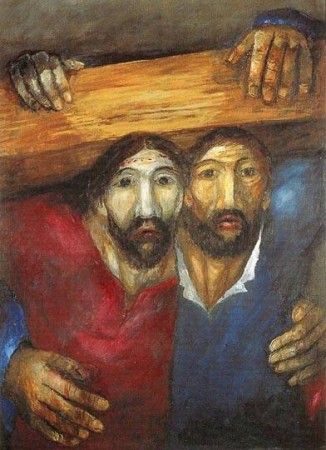
Simon CyreneAnd they compelled a passerby, Simon of Cyrene, who was coming in from the country, the father of Alexander and Rufus, to carry his cross. (Mark 15:21)

Many of us growing up in church know who Simon of Cyrene is. Simon was forced to carry Jesus’ Cross for him on the road to Golgotha. His inclusion in Mark’s account makes sense; when the almighty Son of God’s mortal strength was failing him, Simon helped bear his burden. What makes less sense, initially, is the inclusion of his sons, Alexander and Rufus, who, to our knowledge, did absolutely nothing. Why then should they be there, included in the text? What’s the point in telling us who his sons are, especially when so many others go unnamed in the account, including the relations of prominent disciples, such as Peter’s mother-in-law who was actually the subject of healing (Mark 1:30-31)?

Richard Bauckham steps in to clear things up for us:

…the way Simon is described by Mark — as “Simon the father of Alexander and Rufus” — needs explanation. The case is not parallel to that of Mary the mother of James the little and Joses (Mark 14:40), where the sons serve to distinguish this Mary from others, because Simon (very common though this name was) is already sufficiently distinguished by reference to his native place, Cyrene. Matthew and Luke, by omitting the names of the sons, who that they recognize that. Nor is it really plausible that Mark names the sons merely because they were known to his readers. Mark is far from prodigal with names. The reference to Alexander and Rufus certainly does presuppose that Mark expected many of his readers to know them, in person or by reputation, as almost all commentators have agreed, but this cannot in itself explain why they are named. There does not seem to be any good reason available other than that Mark is appealing to Simon’s eyewitness testimony, known in the early Christian movement not from his own firsthand account but through his sons. Perhaps Simon himself did not, like his sons, join the movement, or perhaps he died in the early years, while his sons remained well-known figures, telling their father’s story of the crucifixion of Jesus. That they were no longer such when Matthew and Luke wrote would be sufficient explanation of Matthew’s and Luke’s omission of their names.

Jesus and the Eyewitnesses: The Gospels as Eyewitness Testimony, pg. 52

What we have here is an early invitation to check with the witnesses. The implication, much as with Paul’s laundry-list of names in 1 Corinthians 15:3-7, is for the reader feel free to ask them about it, should they care to. Simon might be dead, but Rufus and Alexander are living witnesses who can verify what Mark has written about their father.

The constant witness of the New Testament is that the apostles were not teaching “cleverly devised stories” but were dealing with “eyewitnesses of his majesty.” (2 Peter 2:16) Our faith is still faith–it is not yet sight–and yet, it is not blind. We are asked to place whole-hearted trust in credible testimony, human, and ultimately divine, that the promises of God have been fulfilled in Jesus Christ, who, though he was strong, became weak for our sake that day on Golgotha.

Soli Deo Gloria