 For the last 30 or so years (or maybe more), there’s been a running debate surrounding the nature, shape, and origins of New Testament Christology. How high or low was it really? Was Paul really working with a concept of Christ as fully divine and fully human a la Chalcedon, or did that come later as the Church reflected on the implications of what Paul and the other apostles wrote? And did Jesus think himself divine? Was that even an option for a 1st Century Jew? Where did that Christology eventually come from? Was it the influence of Greek, pagan cult, or rooted in classic, Hebrew monotheism? And are these even the right questions? (See Wesley Hill on this)
While much New Testament scholarship in the 20th century took it for granted that “high” Christology was a later development, scholars like Larry Hurtado, Richard Bauckham, Chris Tilling, N.T. Wright, and others, have recently forwarded a thesis of early “Christological Monotheism” that argues the earliest Christology we have is a divine Christology. From the beginning, Paul, John, and the other apostles believed there to be one God (YHWH) and yet, somehow, the man Jesus was central to that one God’s identity (1 Cor. 8, Phil. 2, Col. 1, John 1, etc).
This “emerging consensus” has grown in force and strength over the years, despite variations among the different proponents. Some emphasize the new pattern of reading Scripture that forced the early Christians to recognize Christ as the one who has come and done what only YHWH himself would come and do (Wright), or the fact that he is ascribed the divine Name (Bauckham), or that he receives worship in a way only suited to the Creator in Jewish monotheism (Hurtado). All the same, one thesis that most seem agreed on is that this “Christological monotheism” has no real precedent in the 2nd Temple Jewish texts of the period before Christ.
Crispin Fletcher-Louis disagrees. He does so in a recently published first work of an ambitious, projected four-volume series on the issue, Jesus Monotheism Volume 1: Christological Origins: The Emerging Consensus and Beyond. I’m only about half-way through it, but it’s already proving instructive and provocative. For those interested, in the series, Fletcher -Louis aims both to support and forward the “emerging consensus” while simultaneously critiquing and strengthening it from what he takes to be real weaknesses, due largely from a failure to consider biblical anthropology and theology.
While mostly appreciative of Bauckham and Hurtado’s work (often sharply defending them against critics such as James Dunn or James McGrath), here he says they’ve missed the mark. They say that the various designated emissaries of God such as kings, prophets, priests, nor angelic figures were ever included in the identity of the one God, nor did they receive the kind of worship that Jesus does in the New Testament. Fletcher-Louis thinks that while they are right to point out the real, sharp discontinuity with anything that’s come before in pre-Christian Judaism, their method doesn’t give proper due to the range of thinking about Messianic or medatorial figures present in the 2nd Temple texts discovered by recent scholarship (128-129).
At this point in the study, he notes two problems with their method. First, he thinks they handle key texts idiosyncratically, taking minority positions without showing their work enough. Fletcher-Louis aims to tackle that issue at length later, with case-studies in key texts (130).
Second, and this was the interesting point for me, Fletcher-Louis claims they don’t handle the notion of precedents properly with respect to NT Christology. Obviously, there is no exact precedent. There is a radical discontinuity and difference. There is no direct parallel, nor does the Old Testament explicitly demand the New Testament’s Christology (though it is not inconsistent with it). All the same, Fletcher-Louis says that Hurtado in particular “demands too much of the Jewish material for it ever to hope to gain a proper hearing as a factor in explaining the phenomenon attested in the NT” (131). In other words, Hurtado has too high a criterion for what counts as a “precedent” and so it’s obvious that he won’t find one. There won’t be a precedent for each and every part in a single figure, but given the fact that the “Christological monotheism” of the New Testament has many parts, it can be shown that many of the various parts can be found in other sources, even if the whole is not.
He uses an illustration I found particularly instructive:
The Dominican friar Girolamo Savonarola (1452-98) is generally, reckoned, to have anticipated Luther’s German Reformation with an uprising against the power of the clergy in Renaissance Florence. But the full flowering of the theologcal and ecclesial revolution was only seen several decades later the other side of the Alps in Germany (and Switzerland). Savonarola was an historical precedent for Luther, but by no means did his attempted reformation have all the elements of the theological, ecclesial, and political revolution that would spread from Germany. For the waves of Pentecostal and Charismatic renewal and revival that have overtaken parts of the church in the twentieth century there is precedent in pietistic and popular movements, some of which were focused on visionary and “Spirit” experiences, in the medieval church. But in many ways modern Pentecostalism is theologically (and sociologically) quite peculiar to the twentieth century. Such is the stuff of historical precedent. And sometimes precedent entails a degree of historical causality…but sometimes it only offers an intriguing comparison from another, separate historical context… (131)
In the same way, it’s not that we must find a total package Christological monotheism before Christ for it to count as a precedent, but similar elements. Nor, argues Fletcher-Louis, should we be too worried that some anticipations to the Christology of the New Testament might sideline the uniqueness of Christian claims. On the contrary, the similarities are precisely what can aid us in understanding the distinctive character of Christian worship of Christ in distinction from surrounding movements and theologies in the 2nd Temple literature we find (132).
I find his point well-taken, though, it remains to be seen (at least for me) whether he actually does demonstrate the precedents, or whether he does properly safeguards against some of the parallelomania that’s prevalent in certain quarters of the NT guild. Given the case he’s made so far, though, and this write-up of his work by Andrew Wilson, I’m quite excited to see him make the attempt.
Soli Deo Gloria
 One of the striking things about Jesus’ earthly ministry, was his stark realism about the people he was working with. When the crowds initially huddled around him to make him king, impressed by his outward signs, Jesus did not entrust himself to them, “because he knew all people and needed no one to bear witness about man, for he himself knew what was in man” (John 2:24-25). John Chrysostom
  Merry Christmas! Well, presuming that you haven’t had N.T. Wright steal away your Christmas fun. The usual crew shows up this week to discuss
  There’s no way around it–the miracle of Christmas is a trinitarian event through and through. Contemplating the baby born of the virgin Mary, sleeping in the manger in 1st Century Bethlehem, eventually will draw you into eternity to worship the Triune God, Father, Son, and Holy Spirit. As I was reading Christopher Holmes’ excellent new work on the Holy Spirit this week, I ran across a fantastic passage where he is draws out some of the implications of Augustine’s theology of the Trinity by illustrating them by way of the virgin birth:
 Christianity is inextricably bound up with the notion of sin. The Bible tells the story of the triune God’s rescue mission to redeem rebels out of their sin and guilt, which alienates them from his shared life of light and love. The gospel of Jesus Christ is the central message of how the Son came in the power of the Spirit to conquer sin and death through his own life, death, and resurrection. Without seriously considering the weight of sin, as Anselm so famously urged us to do, we can’t possibly understand the glory, goodness, and mercy of God’s liberation. Neither can we respond to it appropriately with repentance, faith, and worship. This is why Christians have historically spent so much time talking about sin.
 Systematic Theology: The Doctrine of God, Volume 1
  Post-Reformation Reformed Dogmatics, 4 Volumes
 Atonement: A Guide for the Perplexed
 Kevin Vanhoozer and Daniel Treier just came out with a new book on how to do Evangelical theology,
 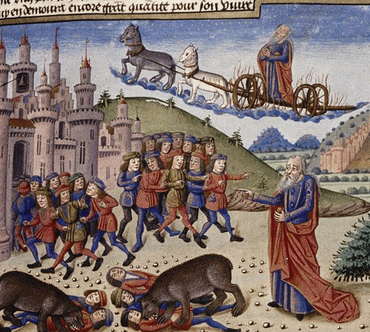 One of the weirdest stories in the narratives of the Old Testament comes at the end of 2 Kings 2 with Elisha and the bears. The deal is that the prophet Elisha has just been anointed by God through his old master the prophet Elijah to succeed him after God took Elijah up to heaven in a vision of God’s holy chariot. Just prophet stuff. In any case, 2 Kings tells of a number of incidents where Elisha is confirming his role as God’s holy prophet by performing similar, miraculous works as Elijah did. As he’s going along, this weird thing happens:
 Ahab’s reign in the Kingdom of Israel was one of the most godless in her whole history. And that’s saying something. Queen Jezebel has instituted worship of the Baals and ordered all the prophets of Yahweh slaughtered. The godlessness is so rampant that Yahweh has the prophet Elijah proclaim a drought and a famine in the land of Israel, in response. If Jezebel and Ahab want the word of Yahweh to dry up in the land, they will suffer the consequences.
 Reformedish