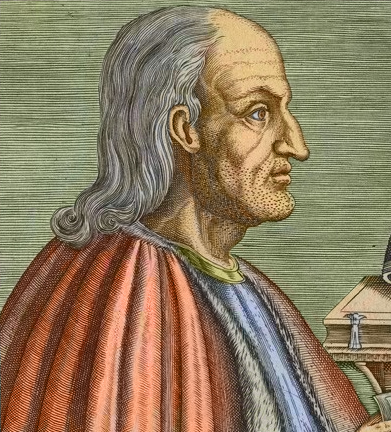
 St. Anselm of Canterbury is almost universally recognized as one of the greatest theological lights of the Western church. This also makes him, along with Augustine and a couple others, one of contemporary theology’s favorite whipping boys. His theological legacy is most commonly linked to two subjects in popular mind: the ontological argument for the existence of God, and the so-called satisfaction “theory” of atonement. Both run in for heavy fire. For instance, have a problem with the Western tradition when it comes to God? Blame Anselm for his attempt to formulate “perfect being” theology via logical argumentation in the Middle Ages. It’s that simple.
From my readings, though, he is far more commonly attacked for his satisfaction account of Christ’s work to atone for our sins and save us through the cross in his classic Cur Deus Homo (Why God Became Man). For those unfamiliar with it, very roughly: humanity has through sin failed to render God the honor due him, have robbed him, violated his law, and thereby fallen under God’s judgment. As the Godman, Christ’s obedient life and death for sin are meritorious in such a way that they “satisfy”, or make up for the damage we have incurred. We are then set free from judgment to be reconciled to God. Incidentally, this is not the only thing Anselm thought about the cross or atonement. Witness early on in the work:
For, as death came upon the human race by the disobedience of man, it was fitting that by man’s obedience life should be restored. And, as sin, the cause of our condemnation, had its origin from a woman, so ought the author of our righteousness and salvation to be born of a woman. And so also was it proper that the devil, who, being man’s tempter, had conquered him in eating of the tree, should be vanquished by man in the suffering of the tree which man bore. Many other things also, if we carefully examine them, give a certain indescribable beauty to our redemption as thus procured. — Cur Deus Homo, Bk. 1.3
I mention this because people who have problems with satisfaction or its more Evangelical descendent, penal substitution account, blame it on Anselm’s logic-chopping and his mindset anchored in the feudal world for reducing the accomplishment of the cross to satisfaction and nothing else.
While there’s something to the charge that the feudal setting influenced Anselm’s formulation, one of the silliest charges I’ve seen crop up against him lately is to say that the account of this premodern medieval theologian is the root of individualistic accounts of sin. Now, I’ll agree that Anselm’s un-mooring of the Scriptural logic from its thicker narrative and cultural context can be problematic. But honestly, can anyone read this passage and tell me we’re dealing with an individualistic account of salvation and sin?
Anselm. It now remains to inquire whence and how God shall assume human nature. For he will either take it from Adam, or else he will make a new man, as he made Adam originally. But, if he makes a new man, not of Adam’s race, then this man will not belong to the human family, which descended from Adam, and therefore ought not to make atonement for it, because he never belonged to it. For, as it is right for man to make atonement for the sin of man, it is also necessary that he who makes the atonement should be the very being who has sinned, or else one of the same race. Otherwise, neither Adam nor his race would make satisfaction for themselves. Therefore, as through Adam and Eve sin was propagated among all men, so none but themselves, or one born of them, ought to make atonement for the sin of men. And, since they cannot, one born of them must fulfil this work. Moreover, as Adam and his whole race, had he not sinned, would have stood firm without the support of any other being, so, after the fall, the same race must rise and be exalted by means of itself. For, whoever restores the race to its place, it will certainly stand by that being who has made this restoration. Also, when God created human nature in Adam alone, and would only make woman out of man, that by the union of both sexes there might be increase, in this he showed plainly that he wished to produce all that he intended with regard to human nature from man alone. Wherefore, if the race of Adam be reinstated by any being not of the same race, it will not be restored to that dignity which it would have had, had not Adam sinned, and so will not be completely restored; and, besides, God will seem to have failed of his purpose, both which suppositions are incongruous: It is, therefore, necessary that the man by whom Adam’s race shall be restored be taken from Adam. —Cur Deus Homo, Bk. 2.8
Whatever else you make of it, Anselm’s entire logic depends on the fact that we are not discrete, atomized individuals, but rather members of a family, a corporate whole that is capable of being represented by either Adam or Christ. This is a robust notion of corporate sin and corporate salvation through corporate solidarity with the person of Jesus, our perfect, human brother. This is completely in line with the Old Testament with its notion of corporate representatives (1 Kings 12, Isaiah 53, Daniel 7). And though different in the details, it parallels and is clearly dependent on Paul’s corporate Adam-Christ logic in Romans 5:
Therefore, just as sin came into the world through one man, and death through sin, and so death spread to all men because all sinned—for sin indeed was in the world before the law was given, but sin is not counted where there is no law. Yet death reigned from Adam to Moses, even over those whose sinning was not like the transgression of Adam, who was a type of the one who was to come. But the free gift is not like the trespass. For if many died through one man’s trespass, much more have the grace of God and the free gift by the grace of that one man Jesus Christ abounded for many. And the free gift is not like the result of that one man’s sin. For the judgment following one trespass brought condemnation, but the free gift following many trespasses brought justification. For if, because of one man’s trespass, death reigned through that one man, much more will those who receive the abundance of grace and the free gift of righteousness reign in life through the one man Jesus Christ. Therefore, as one trespass led to condemnation for all men, so one act of righteousness leads to justification and life for all men. For as by the one man’s disobedience the many were made sinners, so by the one man’s obedience the many will be made righteous. Now the law came in to increase the trespass, but where sin increased, grace abounded all the more, so that, as sin reigned in death, grace also might reign through righteousness leading to eternal life through Jesus Christ our Lord. (Romans 5:12-21)
Heck, jump ahead and you’ll find this in Ireneaus and most of the other church Fathers who don’t get tagged with the “individualism” charge. What’s more, classic penal substitution theology follows him in this via refinements in covenant theology. Adam and Christ are covenant heads whose sin (in the case of the former) and redemptive, holy death (in the case of the latter) have corporate effects for those whom they represent. Read Calvin, or most of the other Reformers and you will not find some atomized theology of merely individual salvation. Yes, each individual is the object of God’s saving grace, but they are so through the union the Mediator of the New Covenant (a very corporate structure).
Now, given then way pop-Evangelicalism has individualized everything, sure, I can definitely see satisfaction and penal substitution accounts being taught in individualistic fashions. That said, there is nothing inherently hyper-individualistic about either of these approaches.
Again, while there’s probably plenty to critique about Anselm’s discussion of the satisfaction element in the atonement, individualism is one charge we should probably leave behind.
Soli Deo Gloria

 Reformedish